Featured post

10 Reasons to be Active in Cancer Recovery

One reason to stay physically active during cancer treatment is because it makes you feel better emotionally and physically.

In the book Active Against Cancer, you can learn more about the medical reasons that exercise helps you heal better from cancer. Being physically active may help you tolerate your cancer treatment better and may help you make a full and lasting recovery from cancer.

The reasons why exercise can help your cancer recovery are explained in easily understood language with medical accuracy. Here is a summary; the book provides further important details.

Five Reasons that Exercise Helps You Heal at a Cellular Level

1. Exercise creates an anti-inflammatory cellular environment, and this helps fight cancer.
2. Exercise boosts the activity of your immune system, and this helps fight cancer.
3. Exercise lowers your stress level and this helps to regulate chemicals like cortisol, which helps fight cancer.
4. Exercise helps to regulate levels of important sex hormones, and this can help fight certain cancers.
5. Exercise helps lower your fat burden in your body, and this can help your body fight cancer at the cellular level.


Five Reasons Exercise Helps Your Body’s Functioning as a Whole

6. Exercise improves your energy-level, reduces your sensations of fatigue, and helps improve your sense of well-being.
7. Exercise can help you sleep better and receive the therapeutic benefits of sleep.
8. Exercise encourages healthy eating helps, improves appetite, helps you to crave nutritious foods, and helps your digestive processes.
9. Exercise lifts mood which in turn helps promote healthy self-care choices, clear thinking, and reduces or avoids depression.
10. Exercise increases your fitness and strength, which can help your body fight illness and recover faster.

Bonus: Exercise is fun!

Spring 2025: Active Season!

Late in April, each year, I count back to the spring when I had my cancer diagnosis. I’m lucky to say that I count back eighteen years now. What a gift! I’m humbled and grateful.

I have weathered some significant health obstacles in the past few years. I have had long periods of time when my usual exercise choices were physically beyond my reach. Luckily, modern medicine had solutions for my problems… again.

Wishing all cancer survivors a happy spring, a mix of inspiration and hope, and the patience to put one foot in front of the other during the difficult times. Sometimes the smallest of steps can really make a difference. I believed that in 2007 when I was in cancer treatment, and I believe it now. Be well.

Sometimes I Remember

When I was in chemotherapy treatment, eleven summers ago, my oncologist liked to try to cheer me up by saying something like this: “Some day, years from now, you will look back and not really remember most of this. It will seem like it wasn’t even real, and you will forget about it.”

I appreciated the intention, but honestly, I didn’t believe him. I was in the midst of the weirdest medical melodrama called “chemo” and I was alternately anxious, worried, and terrified. I was able to handle the pain. What I didn’t like was the uncertainty and weirdness. I thought, when he said I would forget the ordeal, that he was wrong: Not me, I thought, I will always remember all of this in great detail.

However, he knew better than I did. He was right: I did forget. Most of the time, if I happen to think about having had cancer at all, it does seem unreal. It does seem like it couldn’t be true. It does seem like it happened to someone else. I have, in other words, not only re-gained my health and kept cancer-free eleven years, but I have also outlived the trauma.

I don’t worry about recurrence. I don’t feel any difference between who I am now and who I might have been without the cancer-at-age-48 terror. Cancer survivorship doesn’t define me. I wrote a book about cancer recovery, but now I find even that book a little hard to relate to as my own.

Recently, however, I had a week where my own cancer history came back to mind. I recalled it more vividly than I had in many years. Why? Someone whose background I could relate to was diagnosed with cancer–and I found myself remembering the weird time when I went from being super healthy and fit to being a cancer patient.

We all like to think that our choices, like good lifestyle, good nutrition, and good amounts of exercise, will protect us from cancer–and they do, statistically. But even the best lifestyle choices don’t guarantee that cancer will skip by you. Sometimes it picks you, and there may officially be no reason why. You did nothing wrong. You did almost everything right. There is no reason. As an old friend of mine once said, sometimes in life, you have to admit “Why not me?” is about as much logic as you can find in a bad circumstance. “Why not me?”

And there you have the path towards letting go of the “Why me?” when the answer doesn’t appear available. You let go of wondering why it happened, and you just start dealing with it, day by day, bit by bit. You look for how to cope. How to conquer. How to prevail. You look for allies. For tools. For good nutrition, good rest, and good amounts of exercise. You ask for help with pesky side effects; you take the pain and the indignities. You go bald and develop a sense of humor about bald jokes. You get humble; you stay proud. You hang on to close friends, and you learn to enjoy the other members of Club Survivorship, even though it’s a lousy club to be selected for.

You deal with it. Because, as my dad once said of his chemotherapy course, what choice do you have?

A Lap As Caregiver

This past winter, I took a lap around the track as a Caregiver. Not for a cancer patient, but for my husband who shattered his tibia in a skiing accident. And not literally a lap around the track, but hundreds (it seemed) of laps up and down the stairs of the house. It was, overall, a humbling but rewarding time. I learned what it was like to be helping someone who couldn’t keep up with normal activities. I learned things that many caregivers to cancer patients will already recognize. Here are a few highlights.

Pacing. Pacing yourself is key, when you are thrust into doing more than you are used to doing. Winter chores in Vermont include driveway snow removal, stoking the woodstove, bringing in the wood to the house, and mitigating the ice on the driveway, when it appears. When I became the only fully mobile person at our house for a couple of months, those were my jobs, as was cooking, cleaning, shopping and getting rid of trash. Everything could get done, every day, along with taking care of my husband’s care, but I had to really pace myself. It was like an endurance event. I counseled myself: “Don’t go so hard that you can’t get up and do it all again the next day.”

Sometimes it takes a Team. I literally couldn’t do everything that needed to get done some days. We had a few neighbors and friends who pitched in with help with the wood carrying or other things. When I got the flu (!), my husband found a local high scholl baseball team that sent volunteers to the house to help shovel out from a late April snowstorm. Brilliant!

Stay Upbeat. Staying positive was a surprisingly natural reaction to seeing how badly injured my husband was. I became a cheerful caregiver and kept up a good attitude. I am often a real worrier, but I felt so protective of him that I wanted to keep his spirits up by giving him confidence. Now, I’m not perfect at this, and sometimes my worries overflowed a little bit, but I did my best. We picked funny TV shows to binge watch late and night, and we kept his (and my) spirits up through a difficult time.

Celebrate the Little Stuff. There’s nothing quite like a major illness or severe injury to make you realize how good you had it all along. “Boy, it sure was nice when I could walk.” In the next instant, though, you might also realize that you still have it pretty good. My husband and I celebrated the little stuff like sharing good meals, spending extra time together, being able to see healing advancing, and trying to find the humor in the whole medical adventure. It occurred to us often to say: “Well, it could have been worse” and mean it. There was still a lot to celebrate, and doing so kept us appreciating every day, despite the limitations.

Overall, I liked caregiving. I didn’t enjoy getting the flu during this period, but overall, I liked my turn at caregiving. It was interesting to find that it wasn’t actually overwhelming, even though it was very demanding and tiring. The main goal was helping my husband heal and it was good to know that I was making a big difference every day in his healing. And, it was good to take a turn in the Caregiver role. But I won’t mind having his help with snow removal and woodstove filling next year!

Still Active Here…

September 12, 2017

It continues to be a great joy to be physically active and strong. I celebrated 10 years post-ovarian cancer last April. It was a humbling occasion and not without a few tears.

In the last couple of years, as I near 60 years old, more friends have had their struggles with cancer. I lost a dear friend to cancer this past year, and I find I can still not write about it at length. Maybe as time goes on, I’ll find the right words. He was a champion of optimism and strength.

Wishing you each health, long life, and happy trails. And if the trail turns out to be challenging and difficult, wishing you outer support, inner courage and a heart full of love.

To Remember and To Forget

I kept my wig. I kept it, at first, because I didn’t know if I would need again. Then, after some time, I kept it hoping that I would never need it again and thinking maybe that was realistic. Some time later, I kept it because it seemed like “good luck” to keep it.

I wanted to be humble in the face of the threat of cancer. I didn’t want to toy with the threat of cancer recurrence. I wanted to bow to it, humbly, and run hard in the other direction as soon as it wasn’t looking.

Cancer does seem like it was a dream now. A nightmarish dream with lots of love in it. Suffering surrounded by love; fear surrounded by hope; appreciation surrounded by worry. It was a lot. It was not all awful. I was so happy to be alive. So very happy just to be alive.

It is hard to preserve the euphoria of being alive when your days become more routine. Now is the time of casually forgetting all that cancer meant to my life. Now is also the time when it’s important to look back, on purpose, and remember.

Because one thing is true for almost every cancer survivor that I know: Your priorities become very very clear. Get healthy. Enjoy living. Love. Be kind. Do good work. Make the most of it.

I remember the good lessons when I am out in nature. I remember how I healed and what I wanted: to live. To live fully.

Kindred Connections, Vermont

I’m glad to be the keynote speaker tomorrow at the annual meeting for Kindred Connections. It’s a Vermont-based organizations that connects cancer survivors with cancer patients for informal, friendly peer relationships.

I’ll be speaking to the group about my experiences with cancer treatment and exercise, as well as my book and some of my “take-home” points about exercise. One of my themes: Do Something Every Day. Building a habit of daily exercise is profoundly important.

I often wonder if people think that exercise has to be very precisely programmed. I know that I wondered during chemotherapy if I had enough guidance about what to do or not to do. I was told by my physician to “do what you feel like doing”, with the caveat that he didn’t expect I would feel like doing very much after a while.

I had been a competitive cross-country ski racer, before Cancer, and I was used to running half-marathons, training by running mountain trails, and ski racing 32-mile races in mountainous terrain. After surgery for ovarian cancer and in the midst of arduous chemotherapy, I threw my usual fitness routines and fitness goals out the window. I adjusted everything so that my activity served the purpose of recovering from cancer and building health. Fitness and competition could take a hike; I slowed down.

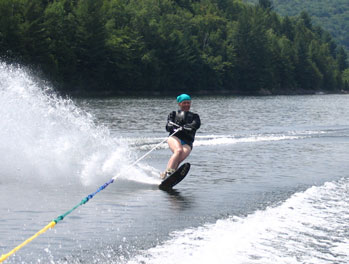
But I didn’t stop. Instead of running, I walked. Instead of swimming far, I swam less far. I swam more slowly. When I was anemic, my walking including stopping and sitting on stonewalls to rest.  I only water-skied a little. (Smiley face here. Yes, I water-skied a little–slalom (ie, one ski). It was a high-point and I chose to do it on the days when I had the best blood counts–and I had asked the MD for clearance to do it.

My point is that I stayed active, but I didn’t try to keep training as if I wasn’t in the middle of chemo. I adjusted. And I tried to do something outdoors, moving, every day as much for pleasure and normalcy as for the health value. I never tried to exhaust myself.

I would recommend this approach to anyone. 1) Do a little as often as daily if you can. 2) Adjust so that you are pursuing health not fitness. 3) Ask your MD or other medical professionals if you have questions about your choices. Let them know your overall exercise plans. 4) Don’t exhaust yourself. 5) Enjoy it! Get outdoors, hear the birds, feel the sunshine, and give yourself the permission to know that a little is often as meaningful to your healing as a lot!

This is what I will tell people tomorrow: Make your exercise plans meaningful for you and you are very likely to aid your healing on many levels: the levels you can measure and the levels you can not. Exercise has immeasurable value to offer your health. Enjoy.

Books Going Home with Patients

50 copies of my book will soon be going home with cancer patients in Vermont thanks to a grant from the Vermont Community Foundation and the efforts of volunteers and others at the Franklin County Kindred Connections organization. Personally, I’m very happy to know that the book will reach people free of charge when they may most find it useful to them.

My book will be given to patients in “Care Bags”, described as “fifty handmade cloth bags filled with thoughtful and caring gifts will be given to newly diagnosed cancer survivors”. The gifts will be given through a collaboration of the Northwestern Medical Center, Crafty Ladies, and various Vermont businesses.

Springing Ahead, 2013

The last twelve months of my six-year cancer survivorship have been a relief. Testing is now only once per year, which really reduces my anxiety!

I have stopped thinking so much about cancer, and started feeling more like “myself”. I started to just be another middle-aged woman wishing she was a little younger looking than she is. I have started to just let all the worries go.

I think that there is increasing awareness in the medical field that helping cancer survivors to exercise has many benefits. Commonly, I see the “stay active” theme at cancer survivor events now. Friends, this trend in cancer survivorship makes me very happy. I hope there are many more local programs and resources where people can work together to enjoy exercise in their lives as cancer survivors.

The best reason to exercise is to try to help save your own life. It’s sooo good for you. The second best reason might be because it’s fun!

Reframing Exercise To Suit Your Goals

I needed to walk the dog on this blustery, cool autumn day, and to be honest, I hesitated. I was wishing it was warmer outdoors. I live in Vermont and when I say “cool” I mean above freezing but not much so. There is snow on the mountaintop a couple of miles away. It’s chilly and cloudy, and by some accounts, the weather is lousy.

But, outdoors I went, wearing a windproof jacket over a fleece sweater. And a fleece hat. After a few minutes of walking, I noticed, that actually, it’s gorgeous outdoors. As someone more clever than me said: “There is no bad weather. Only bad clothes.”

The autumn leaves were blowing around and the wind was noisy. Some bright yellow aspen leaves danced on their branches in a spot of sunshine. My mind cleared, my heart pumped, and I felt glad that I went out for the short walk. My dog, we should mention, is always glad to walk.

What if we were more like our canine companions? What if we didn’t recognize “bad weather” as a deterrent? What if, instead of thinking of our exercise opportunities as “chores” or obligations, we relished them as time to be peaceful, joyful, or quiet the mind. Time to observe nature. Time to feel the sunshine or the rain. Time to stop rushing around in our cars, or surfing on the internet. We can find exercise to be time to heal. Left foot, right foot. Repeat.

The truth is that you can reframe your exercise goals any way you want to. You don’t have to use words like “training” or “workout”. You don’t need to compete in races or have goals to get faster. You can exercise for an hour a day as a meditation, as a path to inner peace, or as a way to feel joyous despite the day’s stresses.

Exercise is not mechanical if you look at it broadly enough. Exercise can also be rich with meaning. I can have special purposes like helping yourself heal or be happy. When you face a hard disease like cancer, you can use exercise as time to heal and reconnect with your body in a nurturing time. You can set aside your suffering and try to find pleasure in your physical movements.

So, reframe exercise to suit your true self. Set your own goals, and make them count for you!

Survivorship Is Always Evolving

Last week, I heard Shannon Miller, gold medal gymnast and ovarian cancer survivor, speak at the University of Vermont. She was sponsored by Fletcher Allen and the Eleanor B. Daniels Fund.

Shannon’s speech was uplifting because of her personal courage and optimism. She was genuine, open, and honest in talking about her experience coping with ovarian cancer, surgery, and treatment. Even though she saved her handstand for the next day on her visit with gymnasts, she radiated with her champion glow–something that her experience with cancer has not changed.

She appears to be winning her cancer challenge, as her health is good right now, over a year after treatment ended.

After the talk, though, a funny thing happened on the way back to my car. I was sad. I didn’t at first know why. I was just sad. In reflecting, I think there are two main reasons.

First, I really hate cancer. All I can say is that I wish that Shannon had not had cancer. She is so young, vibrant, and has a young family. I know in my mind that cancer doesn’t pick its victims in any way that is fair, but honestly, it kind of breaks my heart that she has had to deal with ovarian cancer.

Second, I am now five-year survivor of ovarian cancer. Her talk about diagnosis, the shock, the rigors of treatment, and the fears of recurrence brought back a lot of my worst memories of my own ordeal. I don’t dwell on them often in my day-to-day life any more. But my own cancer survivorship, it seems, is still evolving. That was the first time in a long time I had felt such sorrow.

Shannon mentioned something I thought was important: She said she believed that you need to allow yourself to have your feelings. I believe that, too. Sometimes cancer experiences are frightening, sorrowful, painful, or even maddening on some levels. You can’t just check a box that says: I will always be happy and upbeat in the face of my cancer ordeal. Not going to happen. The toil and troubles of cancer are too rigorous. Everyone will feel sad, hurt, scared or angry at some point. You wouldn’t be human if cancer didn’t upset you.

But, like Shannon said, “When you fall, you get back up.” So, you can accept the so-called “negative” emotions as you feel them, but then you get on with your day. Maybe your day can include getting support or regaining your health by taking care of your body and of your emotions. Get counseling if you need an expert’s help.

Let someone close to you know of your pains, physical and emotional, and then, respond by getting up, moving on, and having a core belief in your ability to cope, your odds of healing, and your inner strength. Everyone has inner strength, with or without gold medals in your past.

April Anniversary, Year Five

Nancy Brennan 2008
Ready to Ski, 2009

Today is the five-year anniversary of my cancer surgery and diagnosis.

I have been free of any signs of cancer since treatment. I have tried to use these years wisely, to help others understand the many benefits of exercise to their cancer recovery. Medical doctors agree; researchers agree; the new guidelines from the American Cancer Society agree: exercise can help you heal as a cancer patient and survivor.

You need to do a small, but consistent, amount of exercise to gain benefits. If you’re in treatment, your exercise volume might be 15 min. a day and still make a difference.

You don’t have to push hard, go fast, or be super-fit to do some meaningful exercise. If you can’t do aerobic activities like walking, you can perhaps do some yoga, stretching or light weight/strengthening work. Avoid inactivity, if you can.

During cancer treatment and recovery, it’s very empowering to take some control of your health through appropriate self-care. Make exercise your refuge and your solace. I wish you much strength and courage as you face cancer and as you recover your health.

Today is a good day to help yourself heal.

Lovely Endorsement

This past year, Shannon Miller, who runs a business named Shannon Miller Healthy Lifestyle, (aka SML) went public with her fight with cancer. Shannon, you may recall, is an Olympic gold medalist in gymnastics.

She is also a wife and mother now. Her ovarian cancer episode was, to many, shocking both because she is young and because she has such a healthy lifestyle. As I know only too well, myself, a healthy lifestyle does not eliminate all cancer risk.

Shannon bravely detailed her cancer challenge on her website’s blog. When Active Against Cancer, my book, was first out, USA Today newspaper ran a story about Shannon’s being in chemotherapy. I sent her the book immediately, and I hoped that it would help her feel encouraged.

Recently, she made this lovely endorsement of Active Against Cancer on her website. She said, in part, “We think all cancer patients and survivors should have this book to share its knowledge [with] all. Many thanks to Nancy for sharing this book with us here at SML!”

Let’s all root for good health for 2012.

Profiled in Active Against Cancer

Ten cancer survivors are profiled in the book; they each used exercise as a way to heal from and cope with cancer treatment. Each profile helps you understand real examples of how cancer survivors stayed motivated, stayed active, and displayed courage during their cancer recoveries.

The amount of exercise that they each did, the type, and the intensity vary, as do their ages and cancer types. What didn’t vary was their commitment to staying active in pursuit of a full recovery.

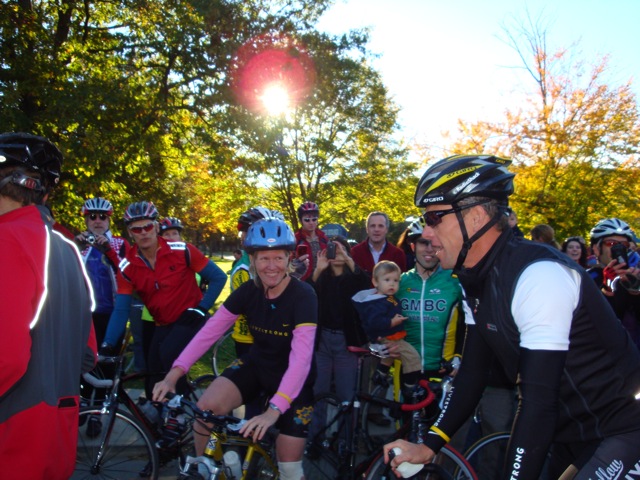
Riding with Livestrong founder, Lance Armstrong, 2011

Here are some of the people who are profiled in the book.

  • A woman who was told to “get her affairs in order” after battling brain cancer, but who, many years later, in 2010, completed a run across the country from California to Florida in one summer. She is an advocate for healthy lifestyles and an author.
  • A man who lives with blood cancer, but who competes in running events including 24-hour run events–at age 69. His doctor applauds his running and healthy lifestyle.
  • A breast cancer survivor and mother who makes time for daily exercise and participated meaningfully in cancer fundraisers such as Romp to Stomp.
  • A former high school and college stand-out athlete, who underwent treatment for her cancer in high school, but whose determination to stay involved in sports and whose recovery made her college sports career possible. She is becoming an oncology nurse. She is also a TNT alum.
  • A woman who is a blood cancer survivor who uses yoga as a daily ritual and helps others in her community experience yoga therapy for the health and well-being.
  • A man who faced colon cancer treatment by including a devotion to exercising at his gym, and whose doctor applauded his activities and commended his ability to tolerate a complete, arduous course of treatment… and succeed.
  • A breast and ovarian cancer survivor who used activity during treatment, and who is a long-time survivor and founder of a foundation for cancer survivors.
  • An ovarian cancer and kidney disease (two transplants) survivor who used bike riding and other activities in her multiple comebacks, and raced in the Livestrong Challenge.
  • An ovarian cancer survivor who used hiking, walking, swimming and water-skiing during her five-month-long chemotherapy, and participated in the Relay for Life Nordicstyle by the American Cancer Society.

Can You Be More Active Against Cancer?

Ask yourself these questions.

1. Am I doing everything that my medical team suggests?

2. Am I doing everything that makes sense to support my health generally? This is called “self-care”.

3. Am I eating well, sleeping as well as I can, and exercising as well as I can?

4. Am I addressing my emotional and spiritual needs? Do I have support?

5. If I could take one step towards better self-care today, it would be to …

6. If I start to exercise better, then I will feel more…

We hope you will find exercise to be a useful tool in your cancer recovery. If you have never loved exercise, maybe you will find that you can now appreciate a short walk or new routine. If you have been a “striver” always reaching for higher performance, maybe you can now appreciate living in the moment and enjoying every step you take.

However you choose to look at exercise, remember that being active is so important that doctors say that if they could prescribe it, they would. Prescribe it to yourself. Check your plans with your medical team, and go enjoy a prescription for life!

Exercise is Natural

From the book, Active Against Cancer, copyright Nancy S. Brennan, all rights reserved.

“I love to see the transformation of people’s spirits–and health–as they become more fit and more accustomed to exercise. I believe that exercise can help turn around anyone’s health and life. Exercise is just natural in a way that sitting at a desk, in a car, or on our couches is not. You know it and I know it. This is a good time to act like your life depends on it!”

Move More, Heal Better

It happened today while I was running. Suddenly, I knew how to summarize two years of research about exercise and cancer recovery:

“Move more, heal better.”

That’s it. Move more, heal better.

Now, this doesn’t mean that you should run up a mountain during cancer treatment, but it means that you should do what you can, appropriately, to stay active as you recover from cancer.

Move more? How much is that? More than not at all. More than a little. More means at least you will move around a little every day, most days. More = not sitting or lying still all day if you can possibly do more than that.

If you are struggling with anemia or side effects of other kinds, moving a little might mean doing 5 yoga postures, doing a little bit of strength work with a stretchy band (Thera-bands) and walking to the end of the block and back. You might be able to dance around your living room or walk the dog. You might be able to swim, even slowly with rests, or float in the pool on a noodle and move your legs.

And if you move more, you will heal better.

Long Distance Thoughts

I set out for a long run, recently, and remembered one of the virtues of a long run: pure relaxation. Planning to run an hour makes it automatic for me to relax for the first five, ten, twenty minutes. There is no pressure to do anything but find a comfortable “go all day” rhythm and relax my mind and body. Because of the distance involved, the first mile is just a happy warm-up and goes by quickly.

It’s not unlike taking a trip in the car. If you plan to go across town quickly on a short trip, it can seem to drag on because in your mind “it shouldn’t take long.” But if you plan to drive for, say, six hours to start your vacation, the first hour will go by in a snap.

So, this got me thinking two things. One: running or exercising for a long duration is easier than you might think. The mind and the body make adjustments. If not the first time, then with a little practice, it will happen that you relax into a long outing. Stay in the moment; don’t worry about how far you have yet to go.

Second thing: Cancer recovery is a long outing, an endurance event, a trip far from your normal life habits. So, too, perhaps in cancer recovery there is a need to relax as much as you can. Pace yourself to go easily. Don’t worry about how long it will all take; just stay in the moment.

That’s my thought for the day. I’m wishing all of you in cancer recovery to build up endurance and find a way to relax during your cancer challenge. Stay hopeful in the moment and try to find the positives in every day, as you make your way back to health.

Refreshing Exercise

At Its best, exercise is refreshing. It can make us feel more alive, calmer, happier, and more energized. That’s a nice combination!

I recently took a one-week vacation on a Maine lake. Swimming and paddling a boat were highlighted activities. At the end of the week, I had re-set my activity level–and my happiness quotient. I felt more energized than in months!

I have been re-habbing from a knee injury and an ACL replacement surgery. Not too much good to say about this injury. It was painful and progress was incremental and slow. My fitness level dropped, as I was on crutches not once but twice, before and after surgery.

Coming back from an injury or from a multi-faceted cancer challenge, you may find that you have limitations in how much you can exercise. You may not get the same uplifted feeling from being active. You may be fatigued and unable to overcome that. How can you be motivated to exercise within new limits?

The trick, if there is one, seems to be in adjusting your expectations. Less may be more. Expect less, and you may find more satisfaction in what you can do. Just do what you can for today.

Perhaps you can change your chosen exercise activities so that they are easier or less intense. Remember, your immune system gets a boost from even a short, slow walk. Perhaps you can enlist a physical therapist to help you make a good tailored plan that’s appropriate for your limitations and abilities.

Then, remind yourself that you are looking ahead to better days!

Do Everything, Don’t Do Too Much

It’s ironic. My two main tenets of cancer recovery seem to be opposite in intent. Do everything that you can to recover from cancer well, and don’t do too much of anything, including exercise. Let’s look closer at this.

I believe that a mindset of “I will do everything I can to beat cancer” is crucial. I wanted to rally; I wanted to show cancer that I was serious about my recovery. Practically speaking, I wanted to use every reasonable remedy or approach that was available.

For me, my tools included: routine acupuncture, an herbalist’s consult, music therapy, guided meditation, yoga, and a nutritionist’s guidance.

These were some of my tools. I took all those tools out of the toolbox to fight cancer. I wanted to use all the tools that made sense to me. I got expert advice where I could, and I was always very careful to follow my doctor’s advice. Anything additional had to fit with my doctor’s advice.

For me, my “do everything” approach meant that I would have no regrets later if my cancer came back. I knew that I was doing the best that I could to fight cancer.

On the opposite side, my goals included “don’t do too much” of any one thing, including exercise. Normally, as an athletic person, I liked to tire myself out sometimes with long runs or events that I do. However, there’s a time to push yourself and a time to respect your limits. Being in cancer treatment is not the time to test your limits with exercise volume or intensity.

The simple exercise guidance that I used was: Don’t push myself to the point where I’m drawing from my reserves or exhausting myself.

So, take it easy! Low to moderate levels of exercise are super helpful. Enjoy! And be good to yourself.

Waterskiing Again: Comeback Two

Nancy Brennan Waterskiing During Cancer Treatment

Waterskiing in Chemo Summer

When I was getting chemotherapy four years ago, I was able to water-ski every few weeks. Thanks to the encouragement of my doctor, husband and brother-in-law, I was able to feel like an athlete, not a cancer patient, for at least the few minutes when I was carving turns on the water. I distinctly remember my first waterskiing on July 4th, the year of my April surgery. I had a memory, while skiing, of being helpless in my hospital bed post-surgery. A big grin broke out on my face, as I skied. I was back to life!

The best thing about being bald that year was that my drysuit fit over my head more easily in the cold water of fall. But, mostly, I remember feeling happy when I skied, as if I was out-smarting my cancer by being so bold and strong. It helped my morale enormously, especially in later months of treatment.

Yesterday, June 6, 2011, I was in the drysuit again and waterskiing for the first time since I broke my leg and hurt my knee in Feb. 2010. I had my ACL replaced in surgery last June. My surgeon recently pronounced my knee excellently healed, and so the water-ski drought is over. I was nervous but popped right up and let out a big “wa-hoo.” Time for more turns in 2011.

Enjoy some activity today, whether you’re 100% healthy or making a long, arduous comeback. Try to do what you can do to be active against cancer and please, have fun doing it if you can.

One Patient is “One Data Point”

I have been mulling over the “one data point” dilemma lately. Here’s what I mean.

When I had cancer treatment, after my major surgery and as my chemotherapy began, I decided to do whatever exercise I could do, in the amounts that seemed beneficial to me. I have always considered exercise to be health-promoting, so there was, in my mind, no reason to stop exercising unless I was medically directed to. I was encouraged to exercise, so I did. I recovered well.

I was able to exercise, with walking, swimming, one long hike once, and some water-skiing. I was fatigued and slowed down, in later months, but I didn’t have to stop exercising during treatment, and I continued to exercise after treatment ended. I credited exercise with helping me cope, helping me eat better, helping me not feel overwhelmed by side effects. My medical team thought that my blood counts came back up, after infusions, very well, and they considered me to be robust throughout treatment and tolerating my chemo very well.

My cancer recovery was also excellent, in terms of my cancer. I have had no evidence of disease since the early part of my chemotherapy treatment. It’s been four years of good health, since then, although no one, not me, or any MD, would say I’m a free from a threat of recurrence. I do have very good odds, at this point, and that is a very good thing. It’s the best I can do.

But does my experience prove that exercise helps in cancer recovery? Not really. Not scientfically speaking. Scientifically speaking, my experience represents only one data point. How do we know that I didn’t just have the ideal surgery and chemo? What if my exercise was irrelevant? Does my experience prove that exercise helped me? How would we prove that? I am just one data point.

I wrote Active Against Cancer because of the convincing and well-accepted evidence that exercise is good for one’s cancer recovery in most cases. The current medical consensus is that exercise has many benefits to cancer patients for whom it is appropriate. That’s great news for cancer survivors who can help their own recovery with pleasurable exercise during and after treatment, in most instances.

I based the book largely on the recommendations of the American College of Sports Medicine’s Roundtable of Exercise Guidelines for Cancer Patients from June 2010. Their expert panel reviewed 140 or so related medical studies and concluded that cancer patients should be encouraged to “avoid inactivity.” I flipped that around and said “be active.” Making a positive goal was important!

My message to you, if you are a cancer survivor is pretty simple. Exercise can help your cancer recovery.

You might just be “one data point” yourself, but so what? Your one life is the one that you want to protect. Do the best you can to make a complete recovery from cancer by following all of your doctors’ advice. In addition, please take care of yourself in other meaningful ways that support your recovery of your health, including exercising appropriately.

Exercising in Nature

This time of year, in Vermont, the leaves are just coming out. We’ve had a lot of rain this year, and the green is a very welcome sight. I was driving back home, along a river, when I remembered: this is the time of year that I was just starting chemotherapy four years ago.

I remember how strange the normal signs of spring looked to me during my cancer ordeal. I felt like I couldn’t get enough of looking at those new signs of life. Spring, always beautiful to see, looked even more potent and life-filled.

I was scared of chemotherapy, and didn’t know how it would be to have chemotherapy drugs (Carbo/Taxol) for six times, every three weeks. I had just had major surgery. But, I remember just looking at the leaves and thinking how beautiful they were.

Nature has always been a tonic to me. It was before cancer, and it certainly was during treatment.

I like to enjoy nature and exercise together. During my cancer treatment, I would walk outdoors often, swim in a lake , or just enjoy walking around the garden. I know some people enjoy “working out” in a gym. I applaud them for their exercise habits, but I’m more comfortable exercising in the natural environment. It adds so much pleasure, for me, to hear the sounds and see the sights of nature around me. It reminds me that I’m alive.

I hope that if you are facing a cancer challenge, you will find a way to make exercise part of your cancer recovery. I also hope you can do some of your exercise in nature.

Does Exercise Beat Cancer?

The working title of my upcoming book, Exercise Beats Cancer, took some criticism today from a friend whom I esteem. Their concern was that a title like Exercise Beats Cancer seems to over-promise results. To them, that title seems to say that if you exercise you can conquer cancer.

Is that true? No. So, why use that title? It could confuse people. Someone might go to their doctor and say, “All I need to do is to exercise, and this book says that I can beat cancer. Why do I need surgery and chemo or radiation?”

Well, I admit, I hadn’t thought of it like that. I certainly didn’t want to imply that exercise was the only tool needed to use against cancer. I don’t want any patients to disregard their doctors’ advice or avoid medical treatment. Not at all.

So, the book’s title has changed. And that’s okay. Thanks for the feedback!