
Category Archives: cancer survivor

Sometimes I Remember

When I was in chemotherapy treatment, eleven summers ago, my oncologist liked to try to cheer me up by saying something like this: “Some day, years from now, you will look back and not really remember most of this. It will seem like it wasn’t even real, and you will forget about it.”

I appreciated the intention, but honestly, I didn’t believe him. I was in the midst of the weirdest medical melodrama called “chemo” and I was alternately anxious, worried, and terrified. I was able to handle the pain. What I didn’t like was the uncertainty and weirdness. I thought, when he said I would forget the ordeal, that he was wrong: Not me, I thought, I will always remember all of this in great detail.

However, he knew better than I did. He was right: I did forget. Most of the time, if I happen to think about having had cancer at all, it does seem unreal. It does seem like it couldn’t be true. It does seem like it happened to someone else. I have, in other words, not only re-gained my health and kept cancer-free eleven years, but I have also outlived the trauma.

I don’t worry about recurrence. I don’t feel any difference between who I am now and who I might have been without the cancer-at-age-48 terror. Cancer survivorship doesn’t define me. I wrote a book about cancer recovery, but now I find even that book a little hard to relate to as my own.

Recently, however, I had a week where my own cancer history came back to mind. I recalled it more vividly than I had in many years. Why? Someone whose background I could relate to was diagnosed with cancer–and I found myself remembering the weird time when I went from being super healthy and fit to being a cancer patient.

We all like to think that our choices, like good lifestyle, good nutrition, and good amounts of exercise, will protect us from cancer–and they do, statistically. But even the best lifestyle choices don’t guarantee that cancer will skip by you. Sometimes it picks you, and there may officially be no reason why. You did nothing wrong. You did almost everything right. There is no reason. As an old friend of mine once said, sometimes in life, you have to admit “Why not me?” is about as much logic as you can find in a bad circumstance. “Why not me?”

And there you have the path towards letting go of the “Why me?” when the answer doesn’t appear available. You let go of wondering why it happened, and you just start dealing with it, day by day, bit by bit. You look for how to cope. How to conquer. How to prevail. You look for allies. For tools. For good nutrition, good rest, and good amounts of exercise. You ask for help with pesky side effects; you take the pain and the indignities. You go bald and develop a sense of humor about bald jokes. You get humble; you stay proud. You hang on to close friends, and you learn to enjoy the other members of Club Survivorship, even though it’s a lousy club to be selected for.

You deal with it. Because, as my dad once said of his chemotherapy course, what choice do you have?

A Lap As Caregiver

This past winter, I took a lap around the track as a Caregiver. Not for a cancer patient, but for my husband who shattered his tibia in a skiing accident. And not literally a lap around the track, but hundreds (it seemed) of laps up and down the stairs of the house. It was, overall, a humbling but rewarding time. I learned what it was like to be helping someone who couldn’t keep up with normal activities. I learned things that many caregivers to cancer patients will already recognize. Here are a few highlights.

Pacing. Pacing yourself is key, when you are thrust into doing more than you are used to doing. Winter chores in Vermont include driveway snow removal, stoking the woodstove, bringing in the wood to the house, and mitigating the ice on the driveway, when it appears. When I became the only fully mobile person at our house for a couple of months, those were my jobs, as was cooking, cleaning, shopping and getting rid of trash. Everything could get done, every day, along with taking care of my husband’s care, but I had to really pace myself. It was like an endurance event. I counseled myself: “Don’t go so hard that you can’t get up and do it all again the next day.”

Sometimes it takes a Team. I literally couldn’t do everything that needed to get done some days. We had a few neighbors and friends who pitched in with help with the wood carrying or other things. When I got the flu (!), my husband found a local high scholl baseball team that sent volunteers to the house to help shovel out from a late April snowstorm. Brilliant!

Stay Upbeat. Staying positive was a surprisingly natural reaction to seeing how badly injured my husband was. I became a cheerful caregiver and kept up a good attitude. I am often a real worrier, but I felt so protective of him that I wanted to keep his spirits up by giving him confidence. Now, I’m not perfect at this, and sometimes my worries overflowed a little bit, but I did my best. We picked funny TV shows to binge watch late and night, and we kept his (and my) spirits up through a difficult time.

Celebrate the Little Stuff. There’s nothing quite like a major illness or severe injury to make you realize how good you had it all along. “Boy, it sure was nice when I could walk.” In the next instant, though, you might also realize that you still have it pretty good. My husband and I celebrated the little stuff like sharing good meals, spending extra time together, being able to see healing advancing, and trying to find the humor in the whole medical adventure. It occurred to us often to say: “Well, it could have been worse” and mean it. There was still a lot to celebrate, and doing so kept us appreciating every day, despite the limitations.

Overall, I liked caregiving. I didn’t enjoy getting the flu during this period, but overall, I liked my turn at caregiving. It was interesting to find that it wasn’t actually overwhelming, even though it was very demanding and tiring. The main goal was helping my husband heal and it was good to know that I was making a big difference every day in his healing. And, it was good to take a turn in the Caregiver role. But I won’t mind having his help with snow removal and woodstove filling next year!

Still Active Here…

September 12, 2017

It continues to be a great joy to be physically active and strong. I celebrated 10 years post-ovarian cancer last April. It was a humbling occasion and not without a few tears.

In the last couple of years, as I near 60 years old, more friends have had their struggles with cancer. I lost a dear friend to cancer this past year, and I find I can still not write about it at length. Maybe as time goes on, I’ll find the right words. He was a champion of optimism and strength.

Wishing you each health, long life, and happy trails. And if the trail turns out to be challenging and difficult, wishing you outer support, inner courage and a heart full of love.

To Remember and To Forget

I kept my wig. I kept it, at first, because I didn’t know if I would need again. Then, after some time, I kept it hoping that I would never need it again and thinking maybe that was realistic. Some time later, I kept it because it seemed like “good luck” to keep it.

I wanted to be humble in the face of the threat of cancer. I didn’t want to toy with the threat of cancer recurrence. I wanted to bow to it, humbly, and run hard in the other direction as soon as it wasn’t looking.

Cancer does seem like it was a dream now. A nightmarish dream with lots of love in it. Suffering surrounded by love; fear surrounded by hope; appreciation surrounded by worry. It was a lot. It was not all awful. I was so happy to be alive. So very happy just to be alive.

It is hard to preserve the euphoria of being alive when your days become more routine. Now is the time of casually forgetting all that cancer meant to my life. Now is also the time when it’s important to look back, on purpose, and remember.

Because one thing is true for almost every cancer survivor that I know: Your priorities become very very clear. Get healthy. Enjoy living. Love. Be kind. Do good work. Make the most of it.

I remember the good lessons when I am out in nature. I remember how I healed and what I wanted: to live. To live fully.

Survivorship Is Always Evolving

Last week, I heard Shannon Miller, gold medal gymnast and ovarian cancer survivor, speak at the University of Vermont. She was sponsored by Fletcher Allen and the Eleanor B. Daniels Fund.

Shannon’s speech was uplifting because of her personal courage and optimism. She was genuine, open, and honest in talking about her experience coping with ovarian cancer, surgery, and treatment. Even though she saved her handstand for the next day on her visit with gymnasts, she radiated with her champion glow–something that her experience with cancer has not changed.

She appears to be winning her cancer challenge, as her health is good right now, over a year after treatment ended.

After the talk, though, a funny thing happened on the way back to my car. I was sad. I didn’t at first know why. I was just sad. In reflecting, I think there are two main reasons.

First, I really hate cancer. All I can say is that I wish that Shannon had not had cancer. She is so young, vibrant, and has a young family. I know in my mind that cancer doesn’t pick its victims in any way that is fair, but honestly, it kind of breaks my heart that she has had to deal with ovarian cancer.

Second, I am now five-year survivor of ovarian cancer. Her talk about diagnosis, the shock, the rigors of treatment, and the fears of recurrence brought back a lot of my worst memories of my own ordeal. I don’t dwell on them often in my day-to-day life any more. But my own cancer survivorship, it seems, is still evolving. That was the first time in a long time I had felt such sorrow.

Shannon mentioned something I thought was important: She said she believed that you need to allow yourself to have your feelings. I believe that, too. Sometimes cancer experiences are frightening, sorrowful, painful, or even maddening on some levels. You can’t just check a box that says: I will always be happy and upbeat in the face of my cancer ordeal. Not going to happen. The toil and troubles of cancer are too rigorous. Everyone will feel sad, hurt, scared or angry at some point. You wouldn’t be human if cancer didn’t upset you.

But, like Shannon said, “When you fall, you get back up.” So, you can accept the so-called “negative” emotions as you feel them, but then you get on with your day. Maybe your day can include getting support or regaining your health by taking care of your body and of your emotions. Get counseling if you need an expert’s help.

Let someone close to you know of your pains, physical and emotional, and then, respond by getting up, moving on, and having a core belief in your ability to cope, your odds of healing, and your inner strength. Everyone has inner strength, with or without gold medals in your past.

April Anniversary, Year Five

Nancy Brennan 2008
Ready to Ski, 2009

Today is the five-year anniversary of my cancer surgery and diagnosis.

I have been free of any signs of cancer since treatment. I have tried to use these years wisely, to help others understand the many benefits of exercise to their cancer recovery. Medical doctors agree; researchers agree; the new guidelines from the American Cancer Society agree: exercise can help you heal as a cancer patient and survivor.

You need to do a small, but consistent, amount of exercise to gain benefits. If you’re in treatment, your exercise volume might be 15 min. a day and still make a difference.

You don’t have to push hard, go fast, or be super-fit to do some meaningful exercise. If you can’t do aerobic activities like walking, you can perhaps do some yoga, stretching or light weight/strengthening work. Avoid inactivity, if you can.

During cancer treatment and recovery, it’s very empowering to take some control of your health through appropriate self-care. Make exercise your refuge and your solace. I wish you much strength and courage as you face cancer and as you recover your health.

Today is a good day to help yourself heal.

Exercise is Natural

From the book, Active Against Cancer, copyright Nancy S. Brennan, all rights reserved.

“I love to see the transformation of people’s spirits–and health–as they become more fit and more accustomed to exercise. I believe that exercise can help turn around anyone’s health and life. Exercise is just natural in a way that sitting at a desk, in a car, or on our couches is not. You know it and I know it. This is a good time to act like your life depends on it!”

Do Everything, Don’t Do Too Much

It’s ironic. My two main tenets of cancer recovery seem to be opposite in intent. Do everything that you can to recover from cancer well, and don’t do too much of anything, including exercise. Let’s look closer at this.

I believe that a mindset of “I will do everything I can to beat cancer” is crucial. I wanted to rally; I wanted to show cancer that I was serious about my recovery. Practically speaking, I wanted to use every reasonable remedy or approach that was available.

For me, my tools included: routine acupuncture, an herbalist’s consult, music therapy, guided meditation, yoga, and a nutritionist’s guidance.

These were some of my tools. I took all those tools out of the toolbox to fight cancer. I wanted to use all the tools that made sense to me. I got expert advice where I could, and I was always very careful to follow my doctor’s advice. Anything additional had to fit with my doctor’s advice.

For me, my “do everything” approach meant that I would have no regrets later if my cancer came back. I knew that I was doing the best that I could to fight cancer.

On the opposite side, my goals included “don’t do too much” of any one thing, including exercise. Normally, as an athletic person, I liked to tire myself out sometimes with long runs or events that I do. However, there’s a time to push yourself and a time to respect your limits. Being in cancer treatment is not the time to test your limits with exercise volume or intensity.

The simple exercise guidance that I used was: Don’t push myself to the point where I’m drawing from my reserves or exhausting myself.

So, take it easy! Low to moderate levels of exercise are super helpful. Enjoy! And be good to yourself.

Waterskiing Again: Comeback Two

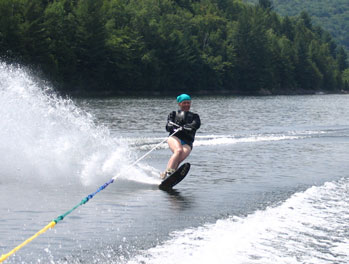
Nancy Brennan Waterskiing During Cancer Treatment

Waterskiing in Chemo Summer

When I was getting chemotherapy four years ago, I was able to water-ski every few weeks. Thanks to the encouragement of my doctor, husband and brother-in-law, I was able to feel like an athlete, not a cancer patient, for at least the few minutes when I was carving turns on the water. I distinctly remember my first waterskiing on July 4th, the year of my April surgery. I had a memory, while skiing, of being helpless in my hospital bed post-surgery. A big grin broke out on my face, as I skied. I was back to life!

The best thing about being bald that year was that my drysuit fit over my head more easily in the cold water of fall. But, mostly, I remember feeling happy when I skied, as if I was out-smarting my cancer by being so bold and strong. It helped my morale enormously, especially in later months of treatment.

Yesterday, June 6, 2011, I was in the drysuit again and waterskiing for the first time since I broke my leg and hurt my knee in Feb. 2010. I had my ACL replaced in surgery last June. My surgeon recently pronounced my knee excellently healed, and so the water-ski drought is over. I was nervous but popped right up and let out a big “wa-hoo.” Time for more turns in 2011.

Enjoy some activity today, whether you’re 100% healthy or making a long, arduous comeback. Try to do what you can do to be active against cancer and please, have fun doing it if you can.

One Patient is “One Data Point”

I have been mulling over the “one data point” dilemma lately. Here’s what I mean.

When I had cancer treatment, after my major surgery and as my chemotherapy began, I decided to do whatever exercise I could do, in the amounts that seemed beneficial to me. I have always considered exercise to be health-promoting, so there was, in my mind, no reason to stop exercising unless I was medically directed to. I was encouraged to exercise, so I did. I recovered well.

I was able to exercise, with walking, swimming, one long hike once, and some water-skiing. I was fatigued and slowed down, in later months, but I didn’t have to stop exercising during treatment, and I continued to exercise after treatment ended. I credited exercise with helping me cope, helping me eat better, helping me not feel overwhelmed by side effects. My medical team thought that my blood counts came back up, after infusions, very well, and they considered me to be robust throughout treatment and tolerating my chemo very well.

My cancer recovery was also excellent, in terms of my cancer. I have had no evidence of disease since the early part of my chemotherapy treatment. It’s been four years of good health, since then, although no one, not me, or any MD, would say I’m a free from a threat of recurrence. I do have very good odds, at this point, and that is a very good thing. It’s the best I can do.

But does my experience prove that exercise helps in cancer recovery? Not really. Not scientfically speaking. Scientifically speaking, my experience represents only one data point. How do we know that I didn’t just have the ideal surgery and chemo? What if my exercise was irrelevant? Does my experience prove that exercise helped me? How would we prove that? I am just one data point.

I wrote Active Against Cancer because of the convincing and well-accepted evidence that exercise is good for one’s cancer recovery in most cases. The current medical consensus is that exercise has many benefits to cancer patients for whom it is appropriate. That’s great news for cancer survivors who can help their own recovery with pleasurable exercise during and after treatment, in most instances.

I based the book largely on the recommendations of the American College of Sports Medicine’s Roundtable of Exercise Guidelines for Cancer Patients from June 2010. Their expert panel reviewed 140 or so related medical studies and concluded that cancer patients should be encouraged to “avoid inactivity.” I flipped that around and said “be active.” Making a positive goal was important!

My message to you, if you are a cancer survivor is pretty simple. Exercise can help your cancer recovery.

You might just be “one data point” yourself, but so what? Your one life is the one that you want to protect. Do the best you can to make a complete recovery from cancer by following all of your doctors’ advice. In addition, please take care of yourself in other meaningful ways that support your recovery of your health, including exercising appropriately.